ADDITIONAL MENU
About the Journal
About the Journal
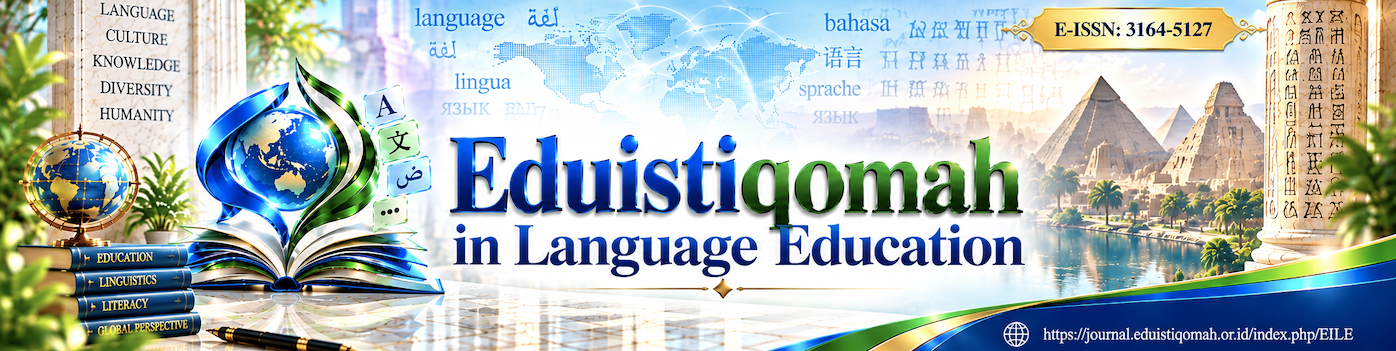
Eduistiqomah in Language Education (EILE) is an international, open-access, peer-reviewed academic journal that focuses on research, innovation, and scholarly development in the field of language education. The journal provides a platform for researchers, lecturers, teachers, educators, linguists, practitioners, and students to disseminate high-quality scholarly works and exchange ideas on contemporary issues in language teaching, learning, assessment, curriculum, and educational development.
EILE welcomes original research articles, review articles, theoretical studies, conceptual papers, and innovative practices that make meaningful contributions to the development of language education. The journal encourages interdisciplinary and multidisciplinary approaches that connect language education with linguistics, educational sciences, psychology, sociology, technology, culture, and other relevant fields.
Focus and Scope
The journal welcomes manuscripts covering, but not limited to, the following areas:
- Language teaching and learning
- English language education
- Arabic language education
- Indonesian language education
- Foreign and second language education
- Applied linguistics and language studies
- Language curriculum and materials development
- Language assessment and evaluation
- Literacy and multiliteracy education
- Multilingual and multicultural education
- Language teacher education and professional development
- Educational technology and digital language learning
- Artificial intelligence and innovation in language education
- Language learning strategies and pedagogical approaches
- Language policy and planning in education
- Translation and interpretation in educational contexts
- Language education at primary, secondary, and higher education levels
- Inclusive, differentiated, and learner-centered language education
- Language education in Islamic and religious educational institutions
- Contemporary issues and emerging trends in language education
Aim and Scope
EILE aims to advance knowledge and practice in language education by publishing rigorous, relevant, and innovative scholarly research. The journal particularly encourages studies that provide theoretical contributions, empirical evidence, methodological innovation, and practical implications for language educators, learners, educational institutions, and policymakers.
The journal also seeks to promote academic collaboration and scholarly dialogue among researchers from diverse linguistic, cultural, national, and educational contexts. Through the dissemination of high-quality research, EILE contributes to the continuous improvement of language teaching, learning, assessment, curriculum development, teacher professional development, and language education policy.
Peer Review Process
Eduistiqomah in Language Education applies a double-blind peer-review process. The identities of authors and reviewers are concealed from one another throughout the review process to promote objective, fair, and independent evaluation.
Each submitted manuscript undergoes an initial editorial screening to assess its relevance to the journal's scope, originality, academic quality, methodological appropriateness, and compliance with the journal's author guidelines. Manuscripts that pass the initial screening are sent to qualified reviewers for further evaluation.
Open Access Policy
EILE is committed to providing immediate and unrestricted access to published scholarly works. All published articles are freely available online without subscription or access fees for readers.
The journal supports the broad dissemination of academic knowledge and encourages researchers, educators, and practitioners to access, read, cite, and use published research in accordance with the applicable licensing conditions.
Publication Ethics
EILE is committed to maintaining high standards of academic integrity and ethical scholarly publishing. Authors, reviewers, editors, and the publisher are expected to uphold principles of honesty, transparency, originality, confidentiality, fairness, and responsibility throughout the publication process.
The journal does not tolerate plagiarism, duplicate publication, fabrication, falsification, manipulation of research data, inappropriate authorship, or other forms of academic misconduct. All manuscripts are subject to plagiarism screening and editorial assessment before publication.
Copyright and Licensing
Authors retain copyright of their published works while granting Eduistiqomah in Language Education (EILE) the right of first publication.
All published articles are distributed under a Creative Commons Attribution (CC BY) license. This license permits others to share, adapt, and reuse the published work provided that appropriate credit is given to the original author(s), the article, and the journal.
Publication Frequency
Eduistiqomah in Language Education (EILE) is published twice a year, in May and November.
Journal Language
EILE publishes scholarly works primarily in English and also accepts manuscripts in Arabic, subject to the journal's editorial standards and language requirements.
Article Processing Charges
EILE provides an affordable and transparent publication model. The applicable article processing charge, if any, is determined by the journal's current publication policy and is communicated clearly to authors before publication.
Archiving and Preservation
EILE is committed to maintaining the long-term accessibility and preservation of its published scholarly content. The journal will implement appropriate digital archiving and preservation practices to ensure that published articles remain accessible to researchers and readers over time.
Our Commitment
Eduistiqomah in Language Education (EILE) is committed to becoming a credible and internationally oriented scholarly forum for the advancement of language education. By emphasizing rigorous peer review, academic integrity, open access, and research relevance, EILE seeks to contribute meaningfully to the development of language education theory, research, policy, and practice at local, national, and international levels.